
Ancient building technologies should inform the way we manage today’s increased risk of flooding and drought, author and designer Julia Watson tells Dezeen in this interview.
Australian-born and trained as a landscape architect, Watson has spent the last two decades investigating traditional techniques for mitigating infrastructure’s impact on the environment.
She argues the pursuit has only become more relevant with the proliferation of urban environments and the rapid growth of AI-related infrastructure – happening against a backdrop of increasing dangers posed by climate change.

“In the next 15 years, we’re going to see 165 cities the size of London pop up around the globe,” she told Dezeen. “We have a choice.”
“[Our work] is about shifting the global conversation around urbanism by proving that there are different ways of doing this, and that it’s incredibly successful.”
Watson is known for developing the concept of Lo-TEK – a play on “low-tech”, with TEK standing for “traditional ecological knowledge”.
She believes an insistence on high-tech solutions to social and environmental problems leaves millennia of learning on the table and alternative paths or “plural futures” unexplored.
“There are multiple avenues for technology and for the way that progress can be envisioned that come from a deeply centred, climate-focused and humanistic stance,” she said.
“Lo-TEK is a regenerative and long-termist approach to thinking about technology, especially climate technology.”
“Water is often spoken about as an existential threat”
Lo-TEK was laid out as a design philosophy in Watson’s first book, Lo–TEK: Design by Radical Indigenism, published in 2019.
The book attracted widespread interest, including from large architecture and engineering firms. Watson noted that she has worked on projects with globally relevant firms such as Buro Happold and Gensler.
Her second book, Lo–TEK: Water: A Field Guide for TEKnology, released this year, looks specifically at how people have adapted over time to ocean and wetland environments.
It highlights global design technologies from ancient fish weirs in the Philippines to artificial islands in the Solomon Islands and the remarkable ancient ice-storage methods of the Persians, with painstakingly gathered photography and diagnostic images.
Far from romanticising what many dismiss as simpler times, the book draws on a series of recent case studies in which traditional technology has been used, such as a hydronic heating system in Canada that integrates knowledge from Cree passive heating systems and a Carles Enrich Studio revival of Barcelona’s ancient canal systems.
Watson’s view is that such examples highlight the need to change not just how we build, but the way in which we imagine the relationship between nature and infrastructure.
“Water is a force which is often spoken about as an existential threat for communities globally – storm surges, heating oceans, hurricanes, and their impacts,” she said.
“But when you speak to indigenous communities, they don’t ever talk about water in that context. They speak about it very relationally, as an ancestor, as the mother’s amniotic fluid, as family, as a teacher. So it’s reframing how we think about water.”
“We haven’t even started to scratch the surface”
What might be read as a bout of idealism about Indigenous knowledge is tempered by Watson’s insistence that the present requires not a total return to pre-industrial living, but an integration of high-tech and Lo-TEK approaches.
“Lo-TEK is inclusive of contemporary technology and contemporary design,” said Watson. “It is the blending of both worlds.”
“Ancestral knowledge is evolving because of its relationship with technology from contemporary society,” she added. “It’s just a continued evolution of that ancestral knowledge system.”
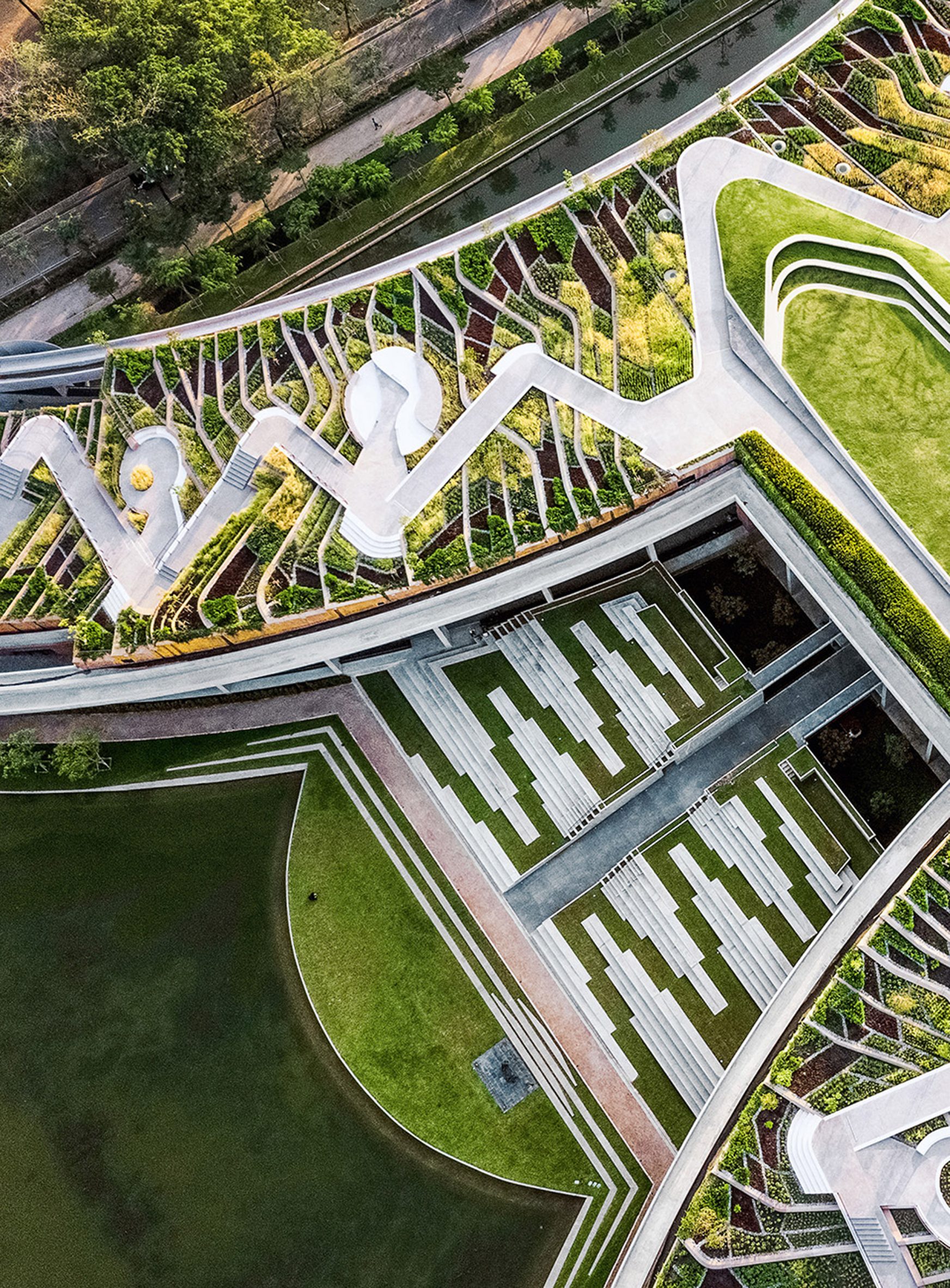
Watson sees the uptake of the “sponge city” concept, developed by late Chinese landscape architect Kongjian Yu, where hard scaping is removed to reduce the blockage of water and biological material by concrete, as an example of the industrial world embracing Lo-TEK.
Increasing interest in circular economies and passive energy systems are other causes for optimism, she says – while stressing there is much further to go.
“We haven’t even really started to scratch the surface,” she said.
China, according to Watson, has areas that are paradigmatic examples of the integration, with its polder dykes and solar fields.
Watson recently co-founded the Lo–TEK Office for Intercultural Urbanism in New York to make real the lofty theoretical frameworks of the books, which deal heavily with how we perceive the world, drawing in different cultural conceptions of technology, society and their interaction with the environment.
Her goal is to help cities adopt the wide variety of Indigenous models according to their specific needs and contexts.
“It’s about holistic, integrated networks and understanding how that works with our cities and our systems, if we really want a long-term approach,” she said.
The photography is courtesy of Julia Watson.
Dezeen In Depth
If you enjoy reading Dezeen’s interviews, opinions and features, subscribe to Dezeen In Depth. Sent on the last Friday of each month, this newsletter provides a single place to read about the design and architecture stories behind the headlines.
The post “Lo-TEK is reframing how we think about water” says Julia Watson appeared first on Dezeen.